Home › Wildlife Removal › Honey Bee Relocation
Live relocation · Comb removal · Cavity repair
Honey Bee Relocation in South Jersey
A honey bee colony in a wall, soffit, or chimney is not a pest problem to be sprayed away. It is a live colony with tens of thousands of bees and pounds of comb inside your structure, and it needs to come out alive and come out completely. Acorn Wildlife relocates honey bee colonies across Camden, Burlington, Gloucester, Mercer, and Cumberland counties, and hands them to beekeepers rather than killing them.
Short answer: We locate the colony, open the cavity, remove the bees and all of the comb, relocate the bees to a beekeeper, and then repair and seal the void so nothing moves back in. Killing a colony inside a wall and walking away is the one approach that guarantees a second problem.
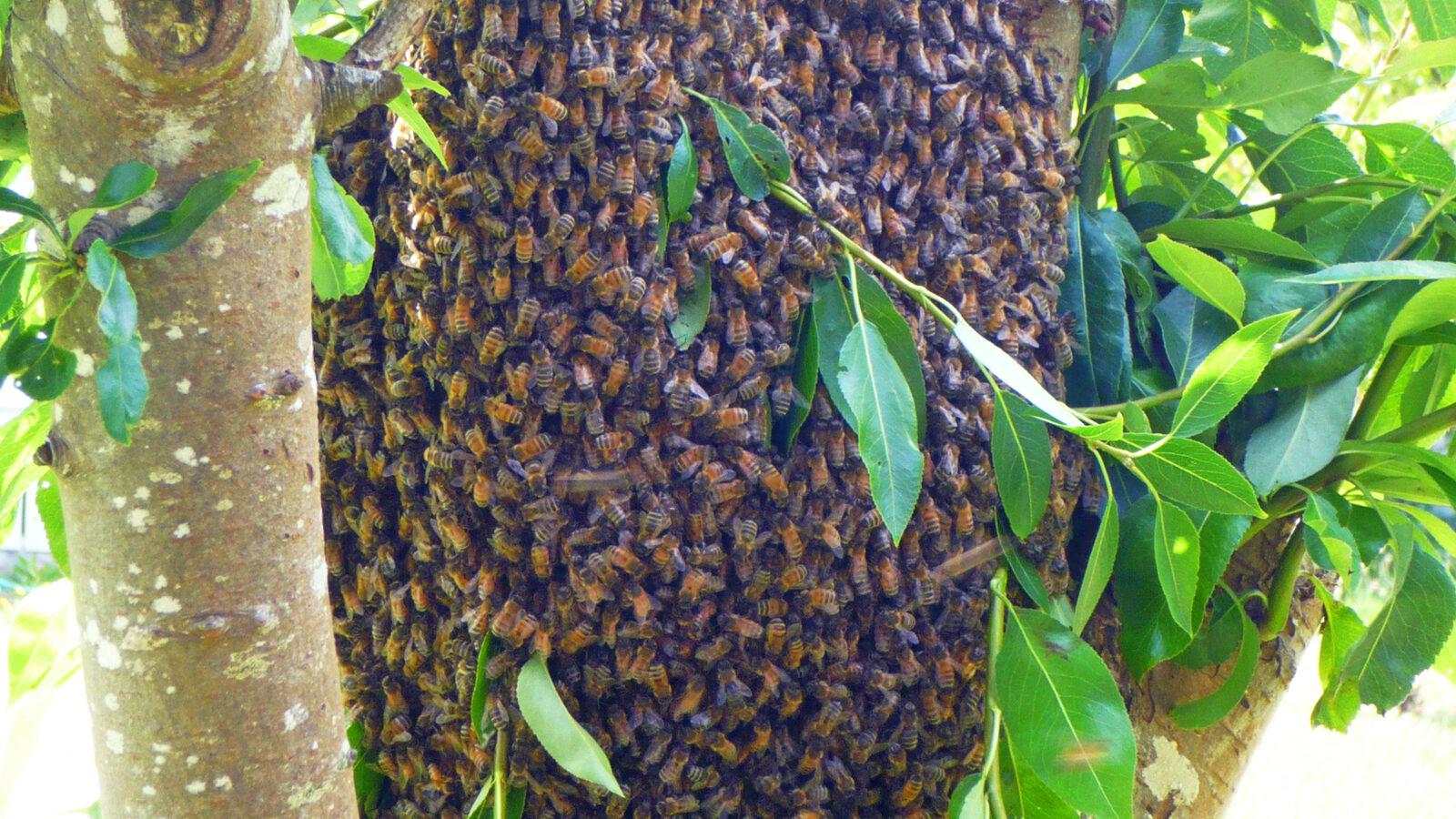
Swarm or Colony? They Are Different Jobs
Short answer: A swarm is a temporary cluster of bees hanging in the open, usually on a branch, fence, or gutter, and it often moves on by itself within a day or two. A colony is established inside a cavity with comb, brood, and honey. Swarms are simple to collect. Colonies inside a structure are a removal and a carpentry job.
A Swarm
A football-sized or larger cluster of bees in the open, with no comb. They are between homes, usually docile, and have nothing to defend. Often collected in a single visit.
An Established Colony
Bees flying in and out of one gap all day, for weeks. Comb is being built inside the void. This is the one that needs the cavity opened.
Where They Settle
Wall voids, soffit returns, chimney flues, gable ends, porch ceilings, and the space above a bay window. The same voids wildlife uses, for the same reason.
The Tell
Steady two-way traffic at one entry point on a warm day, and sometimes a faint hum through the wall or a warm patch on the drywall.
If you can see the cluster and it is hanging in the open, say so when you call. It changes what we bring and how fast we need to get there, because a swarm that settles is a colony by next week.
Why the Comb Has to Come Out
This is the part homeowners are rarely told, and it is the reason spraying a colony inside a wall is such a bad outcome. A established colony holds pounds of wax comb, brood, and honey. Kill the bees and none of that leaves. With no colony left to regulate the hive temperature and no workers capping and tending it, the honey warms, ferments, and runs.
What follows is predictable: honey and wax staining through drywall and ceilings, a lasting odor, and an open larder that draws ants, wasps, rodents, and eventually a fresh bee colony to a cavity that still smells like home. Wax and propolis residue on the cavity walls is a powerful attractant to the next swarm looking for a nest site, which is why untreated cavities get reoccupied season after season.
So a real honey bee job has three parts, and skipping any of them leaves you with a problem: the bees come out alive, the comb and honey come out completely, and the cavity gets cleaned, sealed, and repaired. That last part is ordinary exclusion carpentry, which is what we already do all day.
How an Acorn Honey Bee Removal Runs
Confirm It Is Honey Bees
Plenty of "bee" calls are not honey bees at all. Bumble bees, carpenter bees, yellow jackets, and hornets all get called bees, and every one of them is a different job with a different answer. Send a photo before anything is quoted. Honey bees are the only one of the group we relocate rather than remove.
Find the Actual Cavity
The gap the bees use is not always where the comb is. We trace the colony to the void it occupies so the opening gets made in the right place, which is the difference between one clean access point and a wall opened in three spots.
Open, Remove, Relocate
The cavity is opened, the comb is cut out, and the bees, brood, and queen are collected and passed to a beekeeper who can rehome them. Getting the queen is what makes the relocation stick; without her the remaining bees mill around the old entrance for days.
Clean, Seal, and Repair
The void is cleaned of residual wax and honey, then sealed and the structure repaired. That repair carries the same Acorn Seal-Tight Warranty as the rest of our exclusion work, because it is the same work: a void closed properly so nothing moves back into it.
The Honest Notes
Honey bee removal from a structure means opening the structure. Anyone who tells you a wall colony can be solved from the outside with no access is selling you a dead colony in a cavity. We will tell you at the inspection exactly what has to be opened and what the repair involves before you decide anything.
Honey Bee Relocation Near You
Honey Bee FAQs
Do you kill the bees?
There is a cluster of bees hanging on my tree. Is that an emergency?
Can you just plug the hole they are using?
Are honey bees protected in New Jersey?
How do I know if it is honey bees or something else?
Bees in a Wall, Soffit, or Chimney?
Same-week inspection, honest identification, and a relocation that takes the comb out as well as the bees, with the repair warrantied.