Home › Wildlife Removal › Carpenter Bee Control
Perfect round holes · Gallery treatment · Sealed & repaired
Carpenter Bee Control in South Jersey
Carpenter bees are the ones drilling clean, half-inch holes in your fascia, deck rail, and porch ceiling, and hovering in your face when you walk past. They are not aggressive in any way that matters, but they are genuinely destructive, because they reuse and extend the same galleries year after year until a board is honeycombed. Acorn Wildlife handles carpenter bees across South Jersey as what they really are: a wood problem.
Short answer: Carpenter bees are controlled by treating the active galleries and then sealing and finishing the wood so the next generation cannot reuse them. Plugging the holes without treating first traps bees that simply chew a new exit, and doing nothing about the bare wood guarantees they come back to the same board next spring.
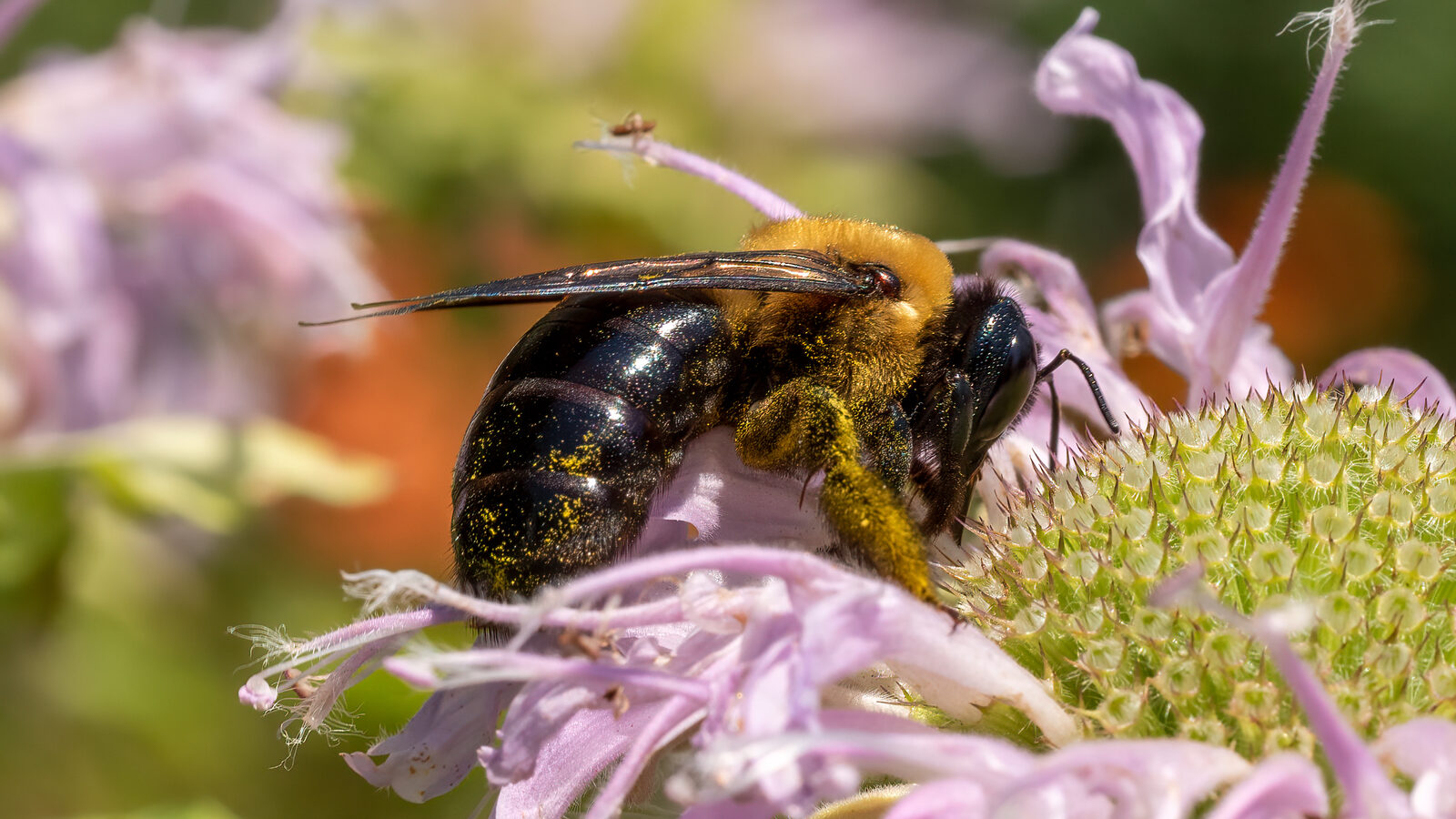
How Do I Know They Are Carpenter Bees?
Short answer: Look for a perfectly round hole about the diameter of your little finger, drilled straight into bare or weathered wood, with coarse sawdust below it and often a yellowish stain running down from the entrance. A big black-and-yellow bee hovering aggressively near it is the male, and he cannot sting.
The Hole
Startlingly round and clean, about half an inch across, cut straight in and then turning at a right angle to run with the grain. No other insect leaves a hole that tidy.
Sawdust & Staining
Coarse shavings on the deck or ground below, and dark or yellow streaking down the wood from the entrance. The staining is waste, and it is what tells you the gallery is active.
The Hovering Male
He patrols the nest area and will fly straight at your face. He has no stinger at all. The female can sting and almost never does unless handled.
Not a Bumble Bee
Carpenter bees have a shiny, hairless black abdomen. Bumble bees are fuzzy all over and nest in the ground. If the abdomen looks polished, it is a carpenter bee.
They favour bare, weathered, unpainted softwood, which in South Jersey means fascia boards, rake boards, deck rails and joists, pergolas, porch ceilings, shed trim, and the underside of anything nobody ever paints. Painted and well-finished wood is markedly less attractive to them, and that fact is the backbone of any lasting fix.
The Damage Is Cumulative, and So Is the Woodpecker Problem
A single season of carpenter bee activity is cosmetic. The problem is that galleries get reused and extended by successive generations, branching along the grain, until a fascia board or deck rail is riddled and structurally soft. That is a multi-year process, which is exactly why it sneaks up on people.
There is a second-order problem worth knowing about. Woodpeckers hunt carpenter bee larvae, and they are very good at it. A row of ragged, excavated gouges along a fascia board where neat round holes used to be is a woodpecker opening up the galleries to feed. At that point you have two problems and considerably more carpentry, and it is common enough in South Jersey that we check for it on every carpenter bee inspection.
Open galleries also let water into end grain, which starts rot in exactly the boards that are hardest to replace. Treating and sealing is cheaper than the fascia.
How Acorn Handles Carpenter Bees
Map Every Gallery, Not Just the Obvious Ones
The holes you can see from the patio are rarely all of them. We work the full perimeter, the underside of rails and joists, and the roofline, because galleries on the back of a board or facing upward are the ones that get missed and are the reason a treated house is buzzing again the following April.
Treat Before Anything Gets Sealed
Active galleries are treated first. This order matters more than anything else on the job: seal a live gallery and the bee simply chews a fresh exit, often through the finished face of the board, leaving you with a new hole and the original problem.
Seal and Finish the Wood
Once galleries are inactive, they are plugged and the surface is made sound again. Bare, weathered softwood is the attractant, so the durable fix is always partly a finishing question. Where boards are already honeycombed past saving, replacement is the honest recommendation, and that is straightforward roofline and fascia work for us.
Timing
Adults emerge and start nesting in spring as the weather warms, which is when activity is most visible and most worth catching. Work done before a season's brood matures prevents the gallery network from expanding. Autumn and winter are the right time for the sealing and finishing half, when nothing is active.
The Honest Note
No treatment makes wood permanently immune. What changes the outcome is keeping the vulnerable wood finished and catching new holes early, which is a maintenance habit rather than a one-visit purchase. We will tell you which of your boards are the real targets so you know where to look each spring.
Carpenter Bee Control Near You
Carpenter Bee FAQs
Will carpenter bees sting me?
Can I just fill the holes with caulk?
Does painting actually help?
Why are there woodpeckers hammering where the bees were?
Will they be back next spring?
Round Holes in Your Fascia or Deck?
Same-week inspection, every gallery mapped, treated in the right order, and the wood sealed so next spring is quieter.