Home › Wildlife Removal › Wasp Removal
Nest removal · Eaves & soffits · Same-week service
Wasp Removal in South Jersey
Paper wasps build the open, umbrella-shaped nests you find under a porch ceiling, inside a grill cover, or tucked behind a shutter, usually at the moment somebody walks into it. They are far less aggressive than yellow jackets, but a nest beside a door you use every day is a genuine problem, and it is not one to knock down with a broom. Acorn Wildlife removes wasp nests across South Jersey.
Short answer: A paper wasp nest is removed at the nest, and the spots that keep attracting them get addressed so next season is not a repeat. Most wasp calls are handled in a single visit. The important part is correctly telling a paper wasp from a yellow jacket or a hornet, because the approach and the risk are different for each.
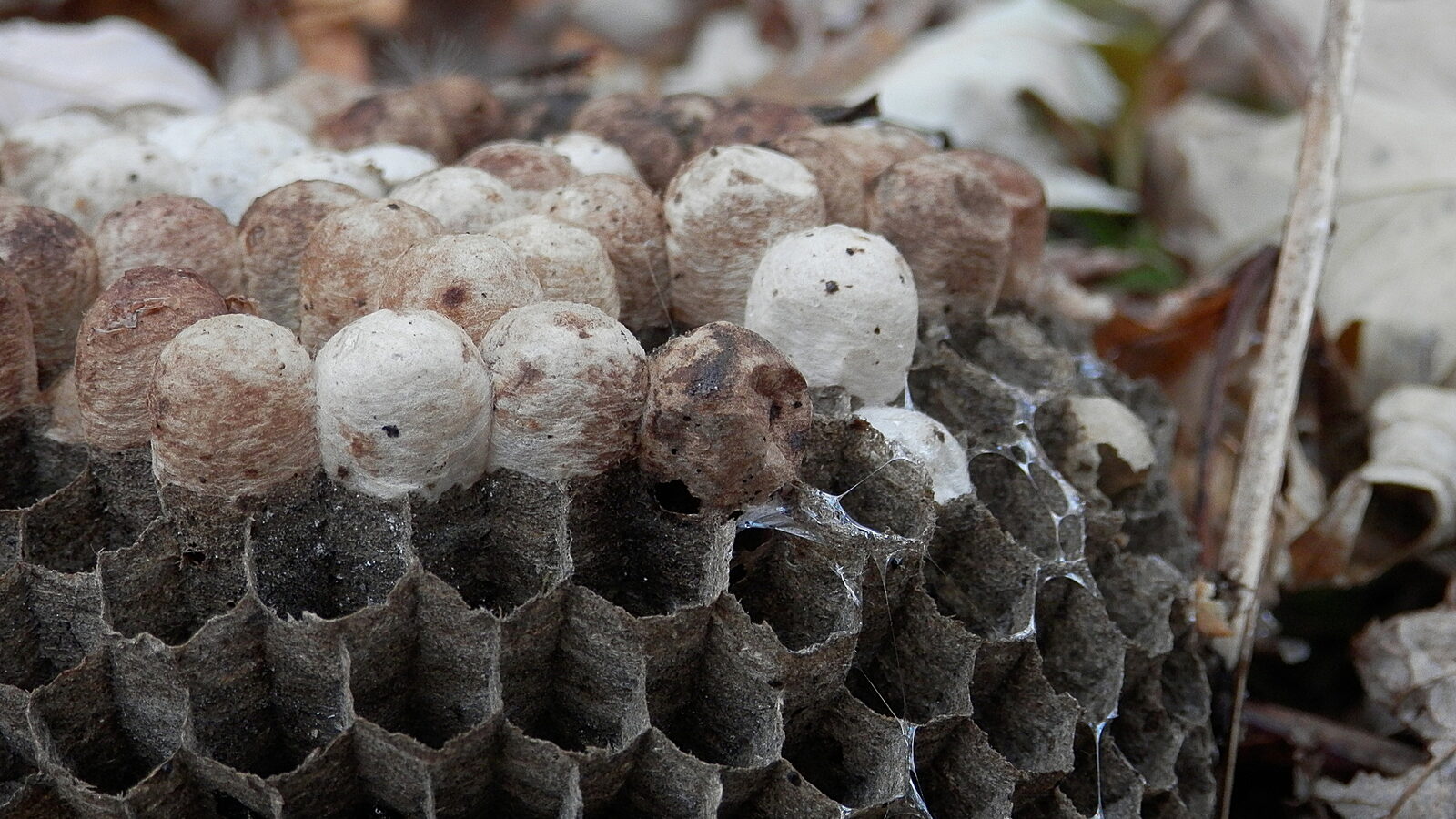
Is It Actually a Paper Wasp?
Short answer: Paper wasps build a single open comb hanging from a short stalk, so you can see the individual cells from below, like a small grey umbrella. If the nest is a closed grey ball with no visible cells, you have hornets. If there is no visible nest at all and traffic runs into a hole in the ground or a wall, you have yellow jackets.
The Open Comb
Cells visible from underneath, no papery envelope around it. Usually the size of a fist or smaller, hanging from a single stalk.
Where They Build
Porch and patio ceilings, door frames, soffit returns, behind shutters, inside grills, mailboxes, playsets, and the top rail of a fence.
The Wasp Itself
Slender, long-legged, with legs that dangle noticeably in flight. Brown with yellow markings, or reddish. Less frantic than a yellow jacket.
Temperament
Defensive only near the nest, and usually only within a couple of feet of it. They do not scavenge at your picnic table the way yellow jackets do.
Correct identification is not pedantry here. Paper wasps are a manageable nuisance; yellow jackets in a wall void are a much larger job; and a bald-faced hornet nest carries the highest risk of the three. A photo from a safe distance settles it before anyone comes out.
Why Knocking It Down Does Not Work
The instinct is to hit the nest with a broom or a hose, ideally from a ladder. It is a bad plan on three counts, and we get the call afterwards often enough to say so plainly.
First, a disturbed nest defends itself, and you are on a ladder. Falls, not stings, are what actually put people in hospital during DIY nest removal. Second, knocking down a comb does not remove the wasps; the survivors rebuild within a few feet, frequently in a worse spot such as inside the soffit rather than under it. Third, a nest under an eave is often a symptom of a gap that also lets other things in, and nobody inspects for that while swinging a broom.
There is also a seasonal reality worth knowing. Paper wasp colonies grow through the summer and peak in late summer, so the same nest that was trivial in June is considerably more defended in September. Early is genuinely easier.
How Acorn Removes a Wasp Nest
Inspect the Whole Elevation, Not Just the Nest You Found
Where there is one paper wasp nest there are usually others, because the conditions that suited the first one suit the rest. We work the full roofline and every sheltered overhang rather than treating the single nest you pointed at, which is the difference between a solved problem and another call in three weeks.
Remove at the Nest
The nest is dealt with directly, at the nest, rather than by spraying in the general direction of the eave from the ground. Most paper wasp work is a single visit.
Close the Sheltered Voids
The follow-through is the part that carries over to next year. Open soffit returns, gaps behind fascia, torn vent screening, and unsealed shutter mounts are prime real estate, and they are exactly the openings we already seal for wildlife exclusion. Closing them takes the sheltered nest sites out of circulation, and that repair is warrantied.
The Honest Notes
Two things we say on every wasp call. Paper wasps are genuinely useful predators that spend their summer taking caterpillars out of your garden, so a nest high on a gable away from every door is reasonably left alone, and we will tell you that rather than sell you a removal. And a nest by a door, a play area, or anywhere someone with a sting allergy passes is worth handling promptly, regardless of how small it looks.
Wasp Removal Near You
Wasp FAQs
How do I tell a wasp nest from a hornet nest?
Are paper wasps dangerous?
Can I wait until winter and let the frost handle it?
They keep rebuilding in the same corner every year. Why?
Do you have to get on a ladder for this?
Nest Over a Door You Use Every Day?
Same-week service, the whole roofline checked rather than the one nest you spotted, and the sheltered gaps sealed so it is not an annual event.