Local & Legal
What Happens to the Animals We Remove?
By Brandon Stein, NJDEP-Licensed Wildlife Control Operator · 8 min read
Short answer: Most animals Acorn Wildlife removes are never trapped: one-way doors let them exit on their own and stay in their home territory, locked out of yours. New Jersey law prohibits relocating rabies vector species off-site, so trapped raccoons, skunks, and groundhogs are released on the property after sealing, and sick animals are humanely euthanized. Babies get reunited with mothers whenever possible.
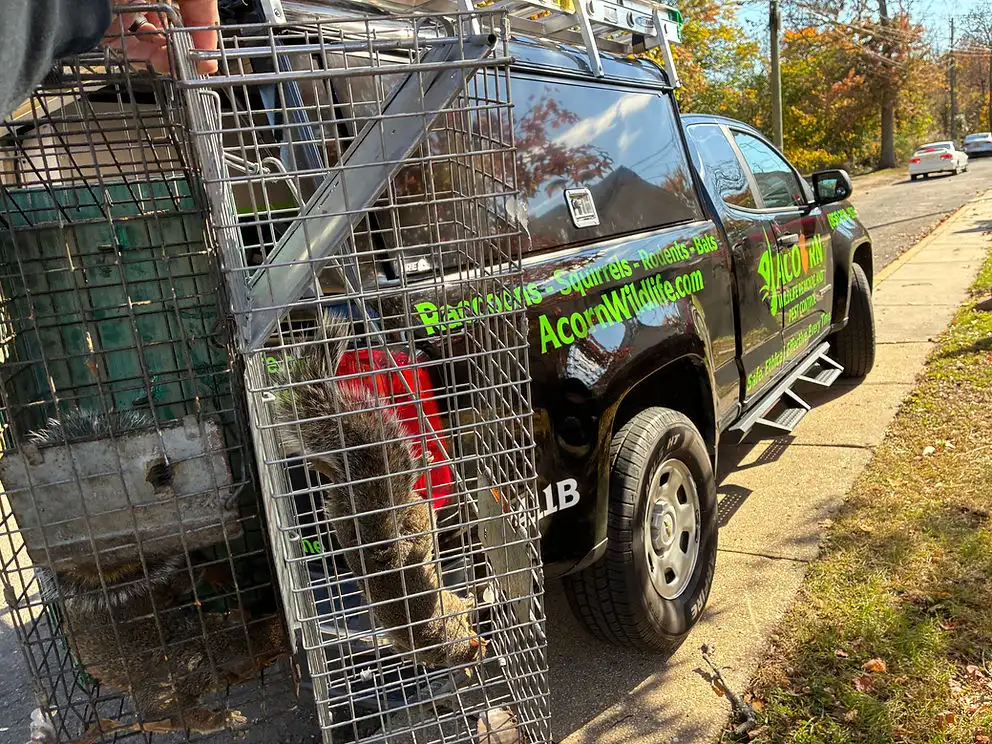
When a family watches us carry equipment toward their attic, somebody, often a kid, eventually asks what happens to the squirrels. We love the question, because the industry's usual answer is a vague "we relocate them humanely," and in New Jersey that answer is frequently either untrue or illegal. Acorn Wildlife in Cherry Hill, NJ would rather explain the real endings, including the two hard ones. Here is where every animal we handle actually goes.
The ending most people never guess: the animal removes itself
The majority of our removals involve no trap, no cage, and no van ride. We install one-way doors over the entry point: the animal pushes out on its normal evening schedule, the door closes behind it, and every other gap is already sealed. It keeps its territory, its food routes, and its backup dens. It just loses access to your attic.
This is the ending we push jobs toward whenever biology allows, and not only because it is kind. It is simply better engineering. A squirrel or raccoon that exits on its own is a calm animal in familiar territory with somewhere to go; wild animals maintain multiple den sites, and losing one means walking to another. A trapped animal, by contrast, is a stressed animal you now owe a legal disposition. One-way exclusion is also what the law prefers for bats, where it is the only method: bats are never trapped or handled in a standard job, they fly out to feed and the device denies re-entry, timed outside New Jersey's May 1 to July 31 maternity blackout so no pups are stranded. When you hear us say removal, picture a door that only opens outward, not a cage in a truck bed.
Why can't you just relocate them to the woods?
Because for the species people most want relocated, it is illegal. New Jersey classifies raccoons, skunks, foxes, and groundhogs as rabies vector species, and NJ Fish and Wildlife rules prohibit moving them off the property where they were captured, a disease-control measure dating to the raccoon rabies epizootic. And beyond the law, relocation quietly fails the animal.
The failure part deserves daylight, because take-it-to-the-woods survives as a comforting story. Relocated animals are dropped into territory already owned by residents of their own species, without known food, water, or dens, often while carrying dependent young left behind. Studies on relocated raccoons and squirrels consistently show high mortality and enormous displacement distances as animals try to walk home. The woods are not empty; that is the whole reason they look like good habitat. So when a company tells you they will relocate your raccoon somewhere nice, one of three things is true: they are breaking New Jersey law, they are describing an on-site release with better marketing, or the animal's actual destination is not what you were picturing. We would rather hand you the real map, which is also the law's map: exclusion first, on-site release after sealing when trapping was necessary, and honest talk about the exceptions below. The method-by-method detail lives on our wildlife removal in South Jersey page.
| Animal & situation | What actually happens | Why |
|---|---|---|
| Squirrels in attic | One-way door exit, entries sealed | Keeps territory; no legal disposition needed |
| Raccoon in attic or chimney | Eviction/one-way exit preferred; if trapped, released on site after sealing | RVS: off-site relocation prohibited |
| Raccoon or squirrel mother with babies | Kits staged in a heated reunion box; mother carries them to her backup den | Every female keeps alternate dens; reunion beats orphaning |
| Bat colony | One-way exclusion devices, no handling, legal timing | Protected species; exclusion is the lawful method |
| Skunk or groundhog under structure | Trap or one-way, on-site release after exclusion, barrier installed | RVS rules plus burrow-inheritance prevention |
| Visibly sick or injured animal | Humane euthanasia, or licensed rehabilitator when treatable | Suffering and disease risk; releasing a sick RVS is illegal and cruel |
| Orphaned young, no reunion possible | Transfer to a licensed NJ wildlife rehabilitator | Only rehabilitators may legally raise wildlife |
What about mothers with babies?
Baby season, roughly March through June for raccoons, with two squirrel litter windows, is when our job becomes midwifery with ladders. The standard play is reunion: young are gently boxed at the exit, warmed, and left overnight; the excluded mother, hearing and smelling them, carries them one by one to one of her backup dens. It works remarkably often.
We stage reunions because the alternative endings are the ones nobody wants: seal an attic with unnoticed kits inside and you get starvation behind your drywall, or trap a nursing female for disposal and you have orphaned a litter you have not found yet. This is also why we probe so annoyingly about timing on spring calls, and why some jobs wait a week that a less careful company would not wait. When reunion genuinely fails, the mother does not return, or young are found abandoned or injured, the animals go to one of New Jersey's licensed wildlife rehabilitators, the only people legally permitted to raise wildlife, and we make that handoff rather than improvising. What we will not do is pretend the timing question away. If a company quotes you a same-day April raccoon seal-up without asking about babies, ask them this post's title and listen carefully.
And the hard ending: when is an animal euthanized?
Two situations, and we will not dress them up. Animals that are clearly sick or badly injured, a distemper raccoon, a mangled groundhog, are humanely euthanized, because releasing a suffering rabies-vector animal is illegal, dangerous, and crueler than the alternative. And rabies-exposure cases, where an animal may have bitten someone, must be euthanized for testing, since the test requires brain tissue.
That is the whole list. Healthy animals do not get euthanized in our shop for being inconvenient; the entire architecture above, doors, reunions, on-site releases, exists to make the hard ending rare. But a wildlife company that claims a 100 percent no-harm record either turns away every sick animal it meets or is telling you a story, and both should bother you. What we owe you, and the animal, is the honest decision tree: exclusion when possible, release on site when trapping was needed, rehabilitation when young are treatable, and a quick, competent, regretted euthanasia when disease or public health closes every other door. That is the same framework NJ Fish and Wildlife licensing holds every operator to; we just think you should get to read it in plain English before the truck arrives.
- Ask any wildlife company these four questions: Do you use one-way doors? What happens to a trapped raccoon under NJ's RVS rules? How do you handle babies in season? When do you euthanize?
- Be suspicious of "we relocate everything to a farm/preserve": for RVS species in NJ, that is either illegal or untrue.
- Expect the timing conversation in spring; a company that never asks about babies is planning to seal them in.
- Verify the NWCO license (ours is NJDEP #92411B); it is what binds the answers above to consequences.
- If you find a sick or injured wild animal yourself, call your ACO or a licensed rehabilitator rather than handling it. Call or Text (856) 398-1028 and we will point you right.
Does on-site release just restart my problem?
Not if the sequence is right: sealing happens before or with the release, so the animal exits into its territory but not back into your house. The warranty on our exclusion work exists precisely because the released animal will test it. That test is the point; the seal wins.
Can I ask you to relocate my raccoon anyway if I don't mind paying more?
No. The RVS relocation ban has no pay-extra tier, and a company that offers one is offering to break the law with your name on the invoice. What we can offer is the exclusion outcome, which solves your actual problem within the rules.
Who pays for the wildlife rehabilitator?
Rehabilitators are mostly donation-funded nonprofits; there is no charge to you when we transfer an orphan, though they gratefully accept support. New Jersey's licensed rehabilitator list is public on the NJ Fish and Wildlife site if you ever need one directly.
Related: Wildlife Removal in South Jersey · Raccoons in New Jersey: The Complete Homeowner's Guide · Squirrel Baby Season in New Jersey