Local & Legal
Who to Call for Stray Dogs & Cats in Burlington County, NJ
By Brandon Stein, NJDEP-Licensed Wildlife Control Operator · 7 min read
Short answer: For a stray dog or cat anywhere in Burlington County, contact your municipality's animal control officer, reached through town hall or the police non-emergency line after hours. Picked-up strays go to the Burlington County Animal Shelter on Academy Drive in Westampton. For wild animals in your home, that is a wildlife company's job, not the ACO's.
Acorn Wildlife works attics and crawlspaces from Maple Shade to Medford, and our contact form has a dropdown option that says "Dog/Cat (we'll point you to the right agency)." People pick it constantly. So consider this the long version of that pointing: the complete stray dog and cat playbook for Burlington County, from a company that handles wild animals only and has no stake in this except getting you to the right phone number the first time.
Who handles strays in Burlington County?
Day to day, your town's animal control officer, every municipality from Moorestown to Medford has one or contracts one, and the reliable route to them is town hall during business hours or the police non-emergency line after. The county's central piece is the Burlington County Animal Shelter at 35 Academy Drive, Westampton, where picked-up strays are held.
Having a genuine county-run shelter simplifies your life in one important way: if you have lost a pet anywhere in the county, there is one primary front door to check, and you should check it in person within a day or two, because New Jersey's stray hold period is seven days before an animal can be made available for adoption. The shelter also runs adoptions, low-cost clinics at various times, and takes owner surrenders by arrangement. What the county shelter does not do is field response; the Westampton facility is where animals land, not who you call to come get one. That call chain is always town-first: your ACO, or the police desk that can raise them. Large rural townships on the Pine Barrens side (Southampton, Tabernacle, Shamong, Woodland) share and contract ACO coverage, so response there can take longer; the dispatch route is identical.
| Situation | Who to call | Notes |
|---|---|---|
| Stray dog loose in the neighborhood | Your town ACO via town hall or police non-emergency | Note direction of travel; photos help enormously |
| Sick or injured stray cat | Town ACO | Healthy free-roaming cats often get no pickup; see FAQs |
| Lost your pet | Burlington County Animal Shelter, Westampton, in person | 7-day stray hold; check often, bring proof of ownership |
| Dog bite, any severity | Police, then Burlington County Health Department | Bites are reportable; this protects you in a rabies review |
| After-hours emergency with a domestic animal | Police non-emergency line | They hold the on-call ACO contacts |
| Cruelty or neglect concern | Local police / county prosecutor's animal cruelty officer | NJ moved SPCA enforcement to prosecutors in 2018 |
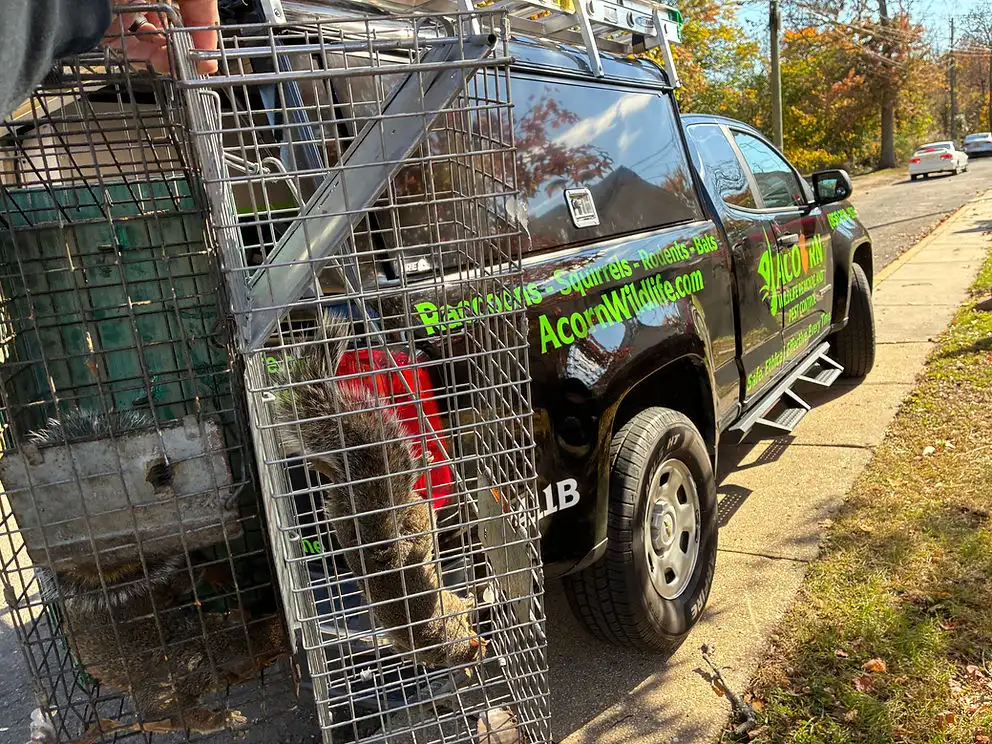
| Raccoon in attic, skunk under shed, bats, squirrels | Acorn Wildlife, (856) 398-1028 | Wild animals only, licensed NJDEP #92411B |
What will animal control actually do?
ACOs respond to at-large and stray domestic animals, injured domestics, bite and exposure incidents, and licensing enforcement. They transport strays to Westampton. What they will not do, in nearly every Burlington County town, is remove healthy wildlife from private property: the squirrels in your soffit are not an ACO call.
The exception that proves the rule is public health. A rabies-suspect animal, a raccoon staggering in your yard at noon, a fox that approached a child, a bat found in a bedroom where someone was sleeping, is very much an ACO and health department matter, and Burlington County's health division coordinates testing in those cases. Do not touch the animal, do not release the bat, make the call. Everything else wild, the healthy-but-inconvenient category that is 95 percent of wildlife encounters, belongs either to nobody (the fox crossing a field in Springfield Township is just living) or to a licensed wildlife control operator when it moves into your structure. That second category is our entire business across the county, detailed on our wildlife removal in Burlington County page, and it is a paid private service precisely because no public agency provides it.
What should you do in the moment?
- Photograph the animal before it moves; a picture plus a cross-street finds more lost dogs than an hour of chasing.
- Contain a friendly dog only if fully safe: fenced yard, garage, leash, water. Skip containment for any dog showing fear or stiffness.
- Have any secured stray scanned for a chip: the Westampton shelter or any vet does it free in minutes.
- Post to town lost-and-found groups; Burlington County's are active and fast, and most strays are neighbors' pets.
- Kittens under the deck: watch 4 to 6 hours for a returning mother before intervening; she is their best outcome.
- Anything that bit or scratched a person: police and health department first, everything else second. No exceptions, it protects the victim during rabies review.
And when is it an Acorn call instead?
When the animal is wild and your house is involved. Thumping over the bedroom in Mount Laurel, a groundhog undermining a Medford stoop, bats above a Moorestown gable vent, a skunk denned under a Cinnaminson shed: that is licensed wildlife work, and it is what we do all day, county-wide.
We built this page because the handoff runs both directions and both directions deserve honesty. When a stray-cat call reaches us, we hand over the ACO route and the Westampton shelter's name and wish you luck, free, no pitch, because dogs and cats are simply not our work and pretending otherwise would serve nobody. When an "animal control won't help me with the raccoon" call reaches us, that is not the system failing; that is the system's actual design, public agencies for domestic animals and public health, licensed private operators for nuisance wildlife. Knowing which lane your problem is in saves you days. Keep this page, or just Call or Text (856) 398-1028 and we will sort your situation into the right lane in one conversation.
Animal control won't pick up a healthy stray cat. Why?
Many NJ towns, Burlington County's included, respond to cats mainly when sick or injured, because healthy free-roaming cats are often owned or community cats and removal rarely sticks. If a cat colony is growing near you, ask the shelter about local TNR (trap-neuter-return) groups, which is the approach that actually shrinks colonies.
How long does the shelter hold a stray before adoption?
New Jersey requires a seven-day stray hold. After that, the animal can be adopted or transferred. If you have lost a pet, visit Westampton in person early and repeatedly; online listings lag what is physically in the building.
A bat was in my bedroom overnight. Animal control or you?
Both, in order. Because someone was sleeping in the room, that is a potential rabies exposure: capture or contain the bat without touching it if safely possible and call the health department about testing, per CDC guidance. Then call us, because a bat in the bedroom usually means a colony in the structure, and finding their entry is our job.
My town borders Camden County and I'm not sure whose animal control to call.
Jurisdiction follows where the animal is standing, not where you live. A stray on the Maple Shade side of a border road belongs to Maple Shade's ACO; two blocks into Pennsauken it becomes a Camden County town's case, and the animal lands at a different shelter. When you are genuinely unsure, call the police non-emergency line for the road you are on and let dispatch sort it; they handle boundary calls daily and will not scold you for guessing wrong. For lost pets near a county line, check both counties' shelters, Westampton and Blackwood, because which truck picked your pet up decides which building it sleeps in tonight.
Related: Wildlife Removal in Burlington County, NJ · Rabies in South Jersey: Actual Risk Numbers · NJ's Bat Blackout Period Explained (Law + Dates)