Species Guides
House Mice in New Jersey: The Complete Homeowner's Guide
By Brandon Stein, NJDEP-Licensed Wildlife Control Operator · 9 min read
Short answer: House mice enter through gaps as small as 1/4 inch, breed year-round indoors with litters every three to four weeks, and contaminate continuously with droppings and urine. Traps alone lose to that math. The durable fix is whole-home sealing of every dime-sized gap, then trapping out the animals cut off inside.
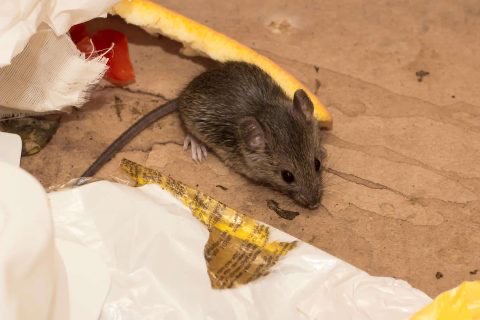
The house mouse is the smallest animal Acorn Wildlife works with and the one most likely to be in your home right now: national housing surveys consistently find rodent evidence in millions of U.S. homes each year, and in our South Jersey inspections, mouse sign turns up in a large share of houses whose owners called about something else entirely.
It is also the species where the standard homeowner response (a few traps and hope) fails most predictably. This guide covers the whole animal: identification, the breeding math that beats trap-only strategies, the real health file, and the sealing-first approach that ends mouse problems instead of managing them.
How do I know it's a house mouse?
Mouse evidence is small, scattered, and close to food: rice-sized droppings (about 1/4 inch, pointed ends) along cabinet backs and drawer corners, faint scratching in walls at night, gnawed corners on food packaging, and a musky ammonia odor in enclosed spaces once numbers build. Sightings are usually a gray-brown blur along a baseboard.
The animal is 2.5 to 3.5 inches of body plus a naked tail about as long again, weighing about half an ounce. The contrast set matters in South Jersey: white-footed mice and deer mice (bicolored, white bellies, common near woods) also enter homes here and carry their own health considerations; young Norway rats read as chunkier with proportionally shorter tails; and rice-versus-3/4-inch droppings separate mouse from rat instantly. Behaviorally, mice are curious where rats are wary, which is why mouse trapping produces fast first-night results and rat trapping does not.
Where the evidence concentrates
- Kitchen: behind the stove and refrigerator, under the sink, in the drawer under the oven
- Pantry: gnawed box corners, droppings on shelf edges
- Garage and basement: along sill plates, in stored fabric and paper
- Utility penetrations: rub marks and droppings where pipes and wires pass through
- Attic edges: mice climb wall voids; insulation tunnels near the eaves are common
What is the house mouse life cycle?
Indoors, house mice breed all year: gestation of about 19 to 21 days, litters of 5 to 6, and a new litter possible every 3 to 4 weeks, with young breeding at 6 weeks old. The often-cited arithmetic that one pair can produce dozens of descendants in a year is conservative in a heated house with a pantry.
Two behavioral facts complete the picture. Mice are territorial homebodies: an established house mouse lives its whole life within about 10 to 30 feet of its nest, which is why droppings cluster and why trap placement is a precision game rather than a coverage game. And mice are climbers: wall voids, wire chases, and rough masonry are vertical highways, so a mouse that entered at the sill plate turns up in the attic three floors up. There is no such thing as a one-room mouse problem for long.
Are house mice actually a health problem?
Yes, quietly. Mice contaminate far more than they eat: a single mouse deposits 50 to 75 droppings and hundreds of micro-droplets of urine daily along its routes. The CDC ties house mice to salmonellosis spread via contaminated surfaces and food, and mouse allergen is a documented asthma trigger, particularly for children, in housing studies.
Two South Jersey-specific notes. First, the deer mice and white-footed mice that enter homes near woods are the species associated with hantavirus; it is rare in New Jersey, but it is the reason cleanup guidance says wet-clean with disinfectant and never dry-sweep or vacuum droppings. Second, white-footed mice are a central host for the ticks that carry Lyme disease, which gives mouse-proofing a small public-health bonus nobody advertises. None of this is panic material. It is the reason mouse problems deserve real fixes instead of coexistence.
What damage do mice do?
Mouse damage is death by a thousand gnaws: wire insulation stripped at junction boxes, upholstery and stored clothing opened for nest material, insulation tunneled and urine-marked, and food losses that are really contamination losses, since a breached pantry item is garbage regardless of how much was eaten.
- Chewed wiring at outlets, junction boxes, and appliance cords (the fire-risk item)
- Nests in stored fabric, paper, and insulation: softball-sized wads of shredded material
- Insulation tunneling and compression in attics and crawl spaces
- Contaminated pantry goods and food-prep surfaces
- Persistent odor in closed rooms as populations grow
How does professional mouse control actually work?
The professional sequence is sealing-first: a full-home inspection finds every gap of 1/4 inch or more (the CDC's dime standard), each one gets closed with steel wool backed by sealant, hardware cloth, or metal flashing, and then snap traps placed on the active routes clear the population trapped inside. Results are measured in quiet nights, usually within two weeks.
Why not poison? The same reasons as rats, compressed: mice on rodenticide die in wall voids and mouse-sized carcasses are nearly impossible to locate; kids and pets share the house with the bait; and poison does nothing about the open gaps, so the population replaces itself. Why not traps alone? Because trapping is subtraction while the entry gaps are addition, and the breeding math above says addition wins. Acorn Wildlife in Cherry Hill, NJ runs mouse control in South Jersey as a whole-home sealing program with trapping included, with the sealing work warrantied. It costs more than a bag of traps and it is the last time you spend money on mice.
How do I keep mice out permanently?
Permanent mouse-proofing is a materials-and-habits list. The materials: steel and mortar at every penetration, brush-style door sweeps, and screened vents. The habits: sealed food storage, managed birdseed, and a yearly walk of the foundation with a flashlight, because houses keep settling and contractors keep drilling new holes.
- Seal every exterior gap 1/4 inch or larger: utility penetrations, sill gaps, corner joints
- Door sweeps on exterior and garage doors that actually touch the threshold
- Steel wool plus sealant for small gaps; hardware cloth for vents and larger openings
- Pantry staples and pet food in glass or heavy plastic containers
- Birdseed stored in metal cans; feeders away from the foundation
- Annual exterior re-check, especially after any contractor work
I caught a few mice and it stopped. Am I done?
Probably not. Trap success drops as the wariest animals remain, and a quiet week is not an empty house. Check for fresh droppings on a cleaned surface for two weeks: fresh sign means the population is still there, and either way the entry gaps that admitted them are still open until someone seals them.
Why do I only hear them in winter?
Because the pantry commute is indoors now. Fall migration brings outdoor mice inside, the furnace masks less noise than you would think, and cold nights concentrate activity in the walls you sleep next to. Summer silence usually means the colony is foraging outside, not that it left.
Are the mice in my shore house different?
Often yes: seasonal and wooded properties get white-footed and deer mice, the bicolored native species. The control approach is identical, but cleanup discipline matters more because of the hantavirus association: wet-clean with disinfectant, gloves and mask, never a dry shop-vac.
Do peppermint oil, dryer sheets, or ultrasonic plugs work?
No. Extension-service and consumer-agency testing has repeatedly found no lasting effect from scent or ultrasonic repellents on established mice; animals habituate within days. The 1/4-inch steel standard is unglamorous and it is the entire game.
How do I clean up after mice safely?
Ventilate the area, wear gloves and a mask, spray droppings and nests with disinfectant or a 10 percent bleach solution until wet, let them sit several minutes, wipe with paper towels, and bag everything. The one rule that matters most: never dry-sweep or vacuum droppings, because aerosolized dust is the exposure route.
If the drawer under your oven is telling a story, Call or Text (856) 398-1028. Acorn Wildlife will find every dime-sized gap in the house, seal them in steel, and trap out the rest, with the inspection included and the work under warranty.
Related:Mouse Control in South Jersey · Rodent-Proofing a House: Real Price Ranges · Norway Rats in South Jersey: The Complete Homeowner's Guide