Species Guides
Norway Rats in South Jersey: The Complete Homeowner's Guide
By Brandon Stein, NJDEP-Licensed Wildlife Control Operator · 9 min read
Short answer: Norway rats are burrowing rodents that enter South Jersey homes at ground level: foundation gaps, crawl spaces, and sewer-adjacent openings. Identification runs on burrows, greasy rub marks, and 3/4-inch blunt droppings. Their breeding math (litters of 6 to 12, maturity at 2 to 3 months) is why sealing plus trapping beats poison every time.
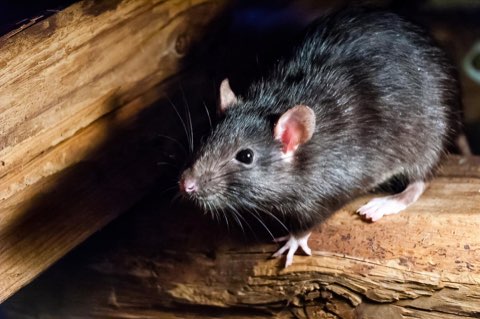
Every rat Acorn Wildlife handles in South Jersey is, with vanishingly rare exceptions, one species: the Norway rat, also called the brown rat or sewer rat. It is the heaviest rodent that gets into local homes, the only one that seriously burrows, and the one whose removal is most often botched with poison. This guide is the whole animal on one page.
How do I know it's a Norway rat?
Norway rats identify themselves at ground level: burrow openings of 2 to 3 inches with fanned dirt near foundations, greasy rub marks along repeated wall routes, droppings about 3/4 inch with blunt ends, and heavy scratching or gnawing heard low in walls or under floors at night. Attic noise is rarely a rat in our area.
The adult is a genuinely big rodent: 7 to 10 inches of body plus a slightly shorter, thick, sparsely haired tail, weighing up to a pound. Brown-gray above, gray below, small ears, blunt snout. The contrast set: house mice are a tenth the weight with delicate features and rice-sized droppings; squirrels are daytime animals with fluffy tails; the roof rat, the climbing species common in the South, is not established in our counties, which is why South Jersey rat work is ground-floor work.
The three signature signs
- Burrows: 2 to 3 inch holes with excavated dirt fans, against foundations, under slabs, beneath sheds and compost bins
- Rub marks: dark, greasy smears at wall bases and hole edges, laid down by oily fur on repeated routes
- Runways: packed-smooth paths along fence lines and foundation edges, swept clean of debris
Rats are neophobic (suspicious of new objects), which is itself a diagnostic: a rat problem often shows weeks of evidence before anyone sees an animal, and new traps get avoided for days. That wariness shapes professional trapping strategy more than any other trait.
What is the Norway rat life cycle?
The Norway rat's biology is a compounding function: gestation of 21 to 23 days, litters of 6 to 12, up to 4 to 6 litters a year, and sexual maturity at 2 to 3 months. A single breeding pair with food and harborage can found a colony of dozens within a season, which is why the response window matters more for rats than any other species we handle.
Rats live in social colonies centered on burrow systems, foraging within roughly 100 feet of home when food allows. Around South Jersey homes the colony is usually outside (under a shed, in an ivy bank, along a fence) with commuters entering the structure for food, until cold weather or a comfortable void moves the nesting inside. The colony structure explains a common homeowner experience: you trapped three rats and the signs continue, because the burrow outside is the source and it restocks.
What do Norway rats do to a house, and what are the health stakes?
Rat damage concentrates low: gnawed sill plates and door corners, burrow undermining at slabs and stoops, torn crawl space insulation and ductwork, and chewed wiring wherever runs pass near travel routes. A rat's incisors exert enormous pressure and grow continuously; concrete crumbs and gnawed lead pipe are not myths, they are Tuesday.
The health file is the longest of any species in this series. The CDC associates rats and their droppings, urine, and fleas with salmonellosis, leptospirosis, and rat-bite fever among others, and contamination is continuous: a rat deposits dozens of droppings and constant urine marking along every route, nightly. Food-contact surfaces and stored pantry goods on a rat route should be treated as contaminated. This is also the species where dead-animal odor problems most often follow DIY poison, which is half of why we argue against it below.
- Gnawing: sill plates, garage door corners, plastic plumbing, wire insulation
- Burrow undermining: stoops, slab edges, shed footings
- Contamination: droppings and urine along every active route, pantry breaches
- Insulation and duct damage in crawl spaces
- Noise: persistent scratching low in walls or under floors, strictly at night
How does professional rat removal actually work?
Real rat work runs exclusion-first: find and seal every ground-level opening of a half inch or more in steel and mortar, cut off the food supply, then trap the animals cut off inside with snap traps placed on the established runways. The sequence matters because rats already inside a sealed house lose their caution fast, and trapping succeeds in days.
Poison deserves its own honest paragraph, because it is what the hardware store sells and what most companies default to. Rodenticide around a home routinely produces three bad outcomes: rats dying in wall voids (odor, flies, and sometimes an opened wall), secondary poisoning risk to owls, hawks, foxes, and pets that eat poisoned rodents, and, critically, zero effect on the next rats arriving through the still-open gap. New Jersey has moved with the national trend restricting second-generation anticoagulants precisely because of the wildlife toll. Sealing plus trapping is slower to describe and better in every measurable way. Acorn Wildlife in Cherry Hill, NJ builds its rat control in South Jersey service on that sequence, with the full-home inspection included.
How do I keep rats from coming back?
Rat prevention is a supply-chain attack: remove food, remove harborage, and keep the structure sealed. Rats need about an ounce of food a day and reliable cover; South Jersey yards supply both through birdseed, pet food, unmanaged compost, ivy banks, and stored junk against fences. Cut the supply lines and the property stops supporting a colony.
- Bird feeders: the single most common rat subsidy we find; use trays and clean spills, or pause feeding during control
- Pet food and water bowls in by dark; chicken coops rat-proofed with hardware cloth
- Compost in sealed tumblers, never open piles with food scraps
- Ivy beds, wood piles, and stored materials pulled back from foundations
- Trash in cans with tight lids, on stands or pads rather than soft ground
- Annual check of door sweeps, vent screens, and utility penetrations
Why did rats suddenly show up on my street?
Usually displacement plus food. Construction, demolition, a neighbor's new chickens, or a change in trash handling moves an existing colony, and the properties with accessible food and cover absorb it. Rats were almost certainly nearby all along; something redirected them, and the fix is making your property the hard target on the block.
I hear scratching in the walls at night. Rats or mice?
Volume and location are the guide. Mice are faint, light, and can be anywhere in the wall height; rats are louder, heavier, and concentrated low, often with audible gnawing. Droppings settle it instantly: rice-sized means mice, 3/4-inch blunt pellets mean rats. Either way the response starts with sealing.
Can rats really come up through the toilet?
It is rare but real: Norway rats are strong swimmers and older sewer laterals with breaks can route them into plumbing. If it happens once, keep lids down and have the lateral camera-inspected, because a broken sewer line is the actual problem, and it is fixable with a one-way sewer valve and repair.
How long does it take to clear a rat problem?
With sealing done properly, most South Jersey homes trap out in 1 to 3 weeks: a few wary days, then rapid captures, then silence. Without sealing, it takes forever, by definition, because the population is being replaced from outside. Any quote that skips exclusion is quoting you a subscription.
Do cats keep rats away?
Not adult Norway rats. Studies of urban rat colonies find cats take juveniles occasionally and adults almost never; a healthy adult rat is a genuinely risky opponent for a house cat. Cats do suppress mice. For rats, the tools are steel, sanitation, and traps.
If there is a burrow against your foundation or grease marks along the garage wall, Call or Text (856) 398-1028. Acorn Wildlife will find every opening, seal the house in steel, and trap out what is left, with the inspection included and the sealing warrantied.
Related:Rat Control in South Jersey · Rodent-Proofing a House: Real Price Ranges · September in South Jersey: The Fall Rodent Rush Begins